Abstract
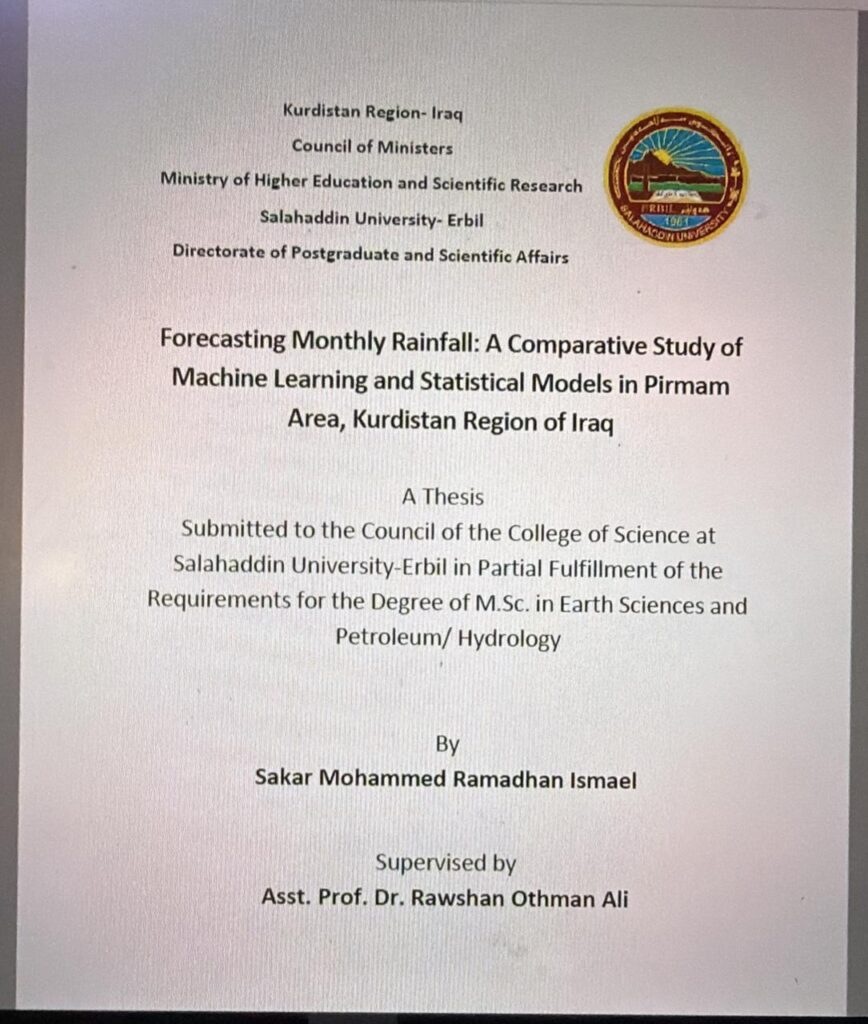
Rainfall forecasting is essential in a number of industries, including agriculture, disaster management, social safety, and water management. The Pirmam area, northeast of Erbil in the Kurdistan Region of Iraq, is characterized by its complicated topography, mountainous nature, and seasonal differences in rainfall, making accurate rainfall prediction not only difficult to achieve but also a crucial element of sustainable water resources management. The main contributor to water in the area is rainfall and hence the main factor in defining the soil moisture, crop productivity, water supply availability, and the sustainability of the ecosystem. The predominant economic activities of the area, which are directly influenced by the patterns of precipitation, are tourism, recreation and agricultural activities. Climate adaptation planning and mitigation of the impact of extreme weather events that occur frequently in semi-arid climate and climate sensitive regions can be enhanced by the existence of reliable monthly rainfall forecasts. This research involves the use of past weather records that were recorded at local meteorological stations in terms of rainfall and other climatic parameters such as temperature, relative humidity, sunshine, evaporation, and wind speed from 1992 to 2020 the data chronological divided 70% used calibration from 1992–2011 and 30% used for validation from 2012-2020. Such a long-term dataset was useful for conduct a powerful assessment of model performance in different climatic conducting. The research also examines the development of predictive modeling, which has moved beyond simple statistical models to more sophisticated machine learning systems, such as Artificial Neural Networks (ANN), Adaptive Neuro-Fuzzy Inference System (ANFIS), Multiple Linear Regression (MLR) and Regularization, e.g., Least Absolute Shrinkage and Selection Operator (LASSO), Ridge Regression (RR), and Elastic Net (ELNET). These models were systematically compared using multiple statistical measures such as the Mean Bias Error (MBE), normalized Root Mean Squared Error (nRMSE), Coefficient of Determination (R²), Root Mean Squared Error (RMSE), and Nash-Sutcliffe Efficiency (NSE) which provide a comprehensive and trustworthy measure of performance. Findings have shown that ANN performed better compared to all other models because it has a higher capability of capturing a complicated nonlinear patterns in rainfall data. The seventh scenario is the most comprehensive scenario in this study. It uses multiple climate variables and their past values to predict monthly rainfall with ANN performed best during validation stage among the tested scenarios. During validation, ANN achieved R² = 0.68, RMSE = 37.30, nRMSE = 12.33, MBE = −1.74, and NSE = 0.677, outperforming all other models and demonstrating robustness for regional rainfall forecasting. In conclusion, this study demonstrates that ANN offers a strong, dependable, and extremely accurate framework for predicting monthly rainfall in the Pirmam area. The model provides useful support for water resource management, agricultural planning, and climate adaptation methods by accurately capturing complex nonlinear patterns in climatically and topographically challenging places. These findings provide scientific evidence to support decision making for sustainable water management and risk mitigation in the Pirmam area, Kurdistan Region of Iraq.