Abstract
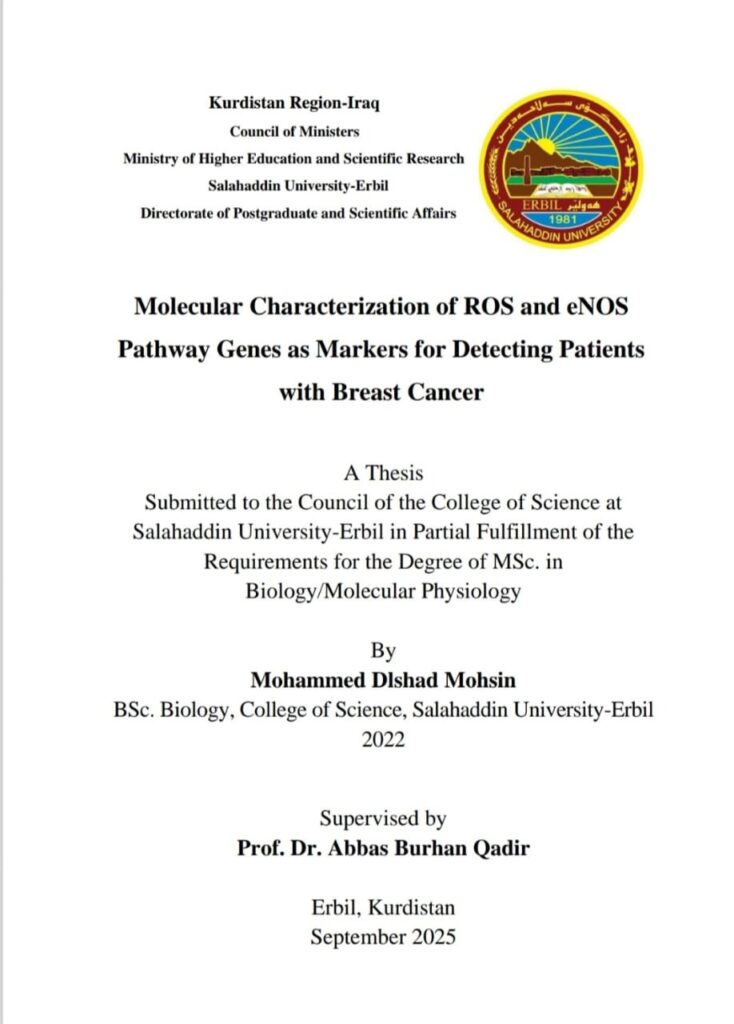
Breast cancer (BC) is the primary cause of cancer-related death among
women globally, highlighting the importance of the identification of novel
biomarkers for early detection and prognosis. The current study investigates
the impact of endothelial nitric oxide synthase (NOS3) and superoxide
dismutase 1 (SOD1) gene polymorphisms on breast cancer development,
focusing on their associations with oxidative stress and tumor progression.
A case-control study including 30 newly diagnosed breast cancer
patients and 30 healthy controls with 27 FFPE samples of the same patients
was conducted. Mutations in NOS3 and SOD1 genes were identified using
Sanger Sequencing. ELISA was used to measure oxidative stress markers such
as peroxynitrite (ONOO-) and superoxide dismutase (SOD). To investigate
functional associations, protein – protein interaction networks were examined
using the GENEMANIA database.
The study identified 32 polymorphisms in the NOS3 gene and 16
polymorphisms in the SOD1 gene, as well as nine amino acids alterations
observed in SOD1 gene. In comparison to controls, BC patients had higher
levels of ONOO- (0.095 ± 0.048 ng/L vs. 0.048 ± 0.057 ng/L, p < 0.0001) and
SOD (0.074 ± 0.033 ng/ml vs. 0.043 ± 0.045 ng/ml, p < 0.001). The GeneMANIA
database analysis showed that the NOS3 and SOD1 genes interact with a
group of proteins that help with cellular redox balance and the response to
oxidative stress. These proteins include peroxiredoxins (PRDX1, PRDX2,
PRDX5, PRDX6), SOD3, and heat shock proteins (HSP90AB1). These
connections, which include physical, co-expression, and pathway links, show
the significance interplay in keeping the cellular homeostasis.
These findings suggest that NOS3 and SOD1 polymorphisms may
contribute to breast cancer pathogenesis, as supported by the observed
oxidative stress alterations (ONOO- and SOD levels). Additional validation in
larger cohort studies is needed to confirm their potential as biomarkers for
risk evaluation and clinical advancement. The study enhances understanding
of the genetic and oxidative stress mechanisms in cancer biology and identifies
potential therapeutic targets for further investigation.